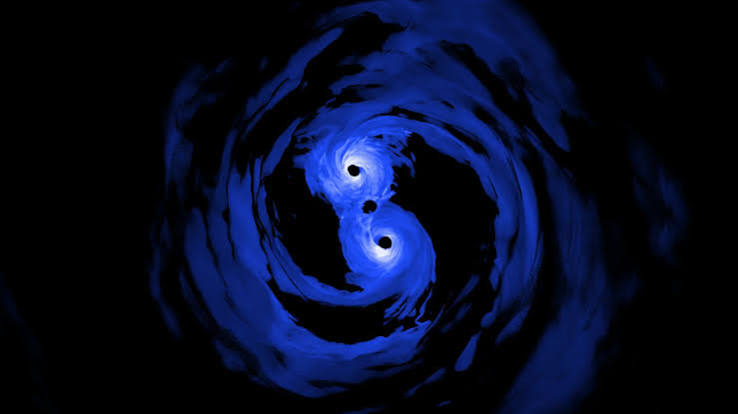
The study doesn't say whether the black hole pair seen 900 million years after the Big Bang will merge. Here is what astronomers expect, and what is still unconfirmed.
Probably, but nobody can say for sure, and the study itself makes no prediction. The paper on the pair, nicknamed Nāpōwawāʻenakaulua, describes two feeding black holes about 18,100 light-years apart in a region where galaxies were colliding, according to the NOIRLab release carried by EurekAlert. It does not say whether or when they will combine. Astronomers expect black holes in colliding galaxies to sink toward each other and eventually merge, but how long that takes varies a lot from pair to pair.
Probably, but nobody can say for sure, and the study itself makes no prediction. The paper on the pair, nicknamed Nāpōwawāʻenakaulua, describes two feeding black holes about 18,100 light-years apart in a region where galaxies were colliding, according to the NOIRLab release carried by EurekAlert. It does not say whether or when they will combine. Astronomers expect black holes in colliding galaxies to sink toward each other and eventually merge, but how long that takes varies a lot from pair to pair.
If you have just read what the James Webb Space Telescope found, this is what is known about what happens to a pair like this, and what is still uncertain about the pair itself.
We are looking at the past
The light Webb and the Gemini North telescope caught left the pair when the universe was “only a thirteenth of its age,” lead author Silvia Onorato of NSF NOIRLab said in the release. That light has been on its way for most of the universe’s history.
So the question is not whether these black holes will merge someday. If they merged, it happened long ago, and it cannot be seen yet. The image is a snapshot of one moment early in the universe’s history.
How black holes in colliding galaxies end up merging
When galaxies merge, their central black holes sink toward the middle of the new combined galaxy and eventually coalesce, the European Space Agency explains in material on gravitational waves from black hole mergers. The team behind the new find says galaxy collisions fed gas and stars to these two black holes and made them shine as quasars, according to the University of Arizona’s Steward Observatory, whose astronomer Xiaohui Fan is on the team.
How long the sinking takes depends on the galaxies. In a December 2025 simulation study of pairs of active black holes, Nianyi Chen and colleagues found that about 30% to 70% of the simulated pairs coalesced within roughly a billion years. That is a figure for a whole simulated population, not a forecast for this pair, and the study is a preprint on arXiv.
For scale, a billion years is longer than the universe had existed when the light we now see left Nāpōwawāʻenakaulua.
How would anyone detect a merger like this?
Not with light alone. Merging black holes send out gravitational waves, ripples in space itself. Giant black holes produce waves at frequencies too low for detectors on the ground, and two approaches are being used to catch them.
Pulsar timing arrays watch dead stars that flash with clock-like regularity. In June 2023 the NANOGrav collaboration reported evidence of a low-frequency gravitational-wave background in 15 years of data from 68 pulsars, with similar results from teams in Europe, India, Australia and China. One possible source is pairs of supermassive black holes, a possibility the researchers were still testing.
LISA, a trio of spacecraft flying in a triangle with arms about 1.6 million miles (2.5 million km) long, is designed to pick up the waves from giant black holes colliding at the centers of galaxies. ESA approved it in January 2024 and plans to launch it in 2035 on an Ariane 6 rocket. NASA is a partner and describes the launch as slated for the mid-2030s.
Neither will show what happened to this particular pair. Their value is in counting how often black holes like these merge across the universe, which tests the idea that early collisions helped them grow so big so fast.
Is it definitely two black holes?
Almost certainly, but there is one check the team has not finished. A massive galaxy in front of a single quasar can bend its light and make it look like two, an effect called gravitational lensing. A 2009 Hubble test of whether that was happening here was inconclusive, according to Steward Observatory.
The two objects’ light differs in Gemini spectra, which favors a real pair, but “a lens model is needed to definitively rule out gravitational lensing,” the release says.
How this pair compares with the other one from the same era
In 2024, Yoshiki Matsuoka of Ehime University reported another quasar pair seen about 900 million years after the Big Bang. Sci.News reported that gas links those two quasars and that their galaxies are in the process of merging. That gas supports the view that they are merging. The releases on the new pair, whose black holes are about 1.5 billion and 400 million times the Sun’s mass, describe colliding galaxies around it but do not describe the two as merging.